# UpRock White Paper
Empowering People with a Real-time AI Insight Exchange through Decentralized Physical Infrastructure
> *“From caveman’s rock to sapiens UpRock: unleashing AI Insight-as-a-Service for enhanced sapience.”*
## Abstract
In the age of information overload, the power of AI to decipher and deliver insights is undeniable. However, this potential has been largely monopolized by centralized entities, raising concerns of censorship, bias, and inadequate real-time relevance. UpRock emerges as the antidote, harnessing the principles of decentralization and web3 technology to reshape the AI landscape.
UpRock is pioneering the democratization of advanced AI web crawling and data synthesis, a privilege previously reserved for large enterprises. By balancing centralized AI with decentralized physical infrastructure, UpRock is architecting a framework for impartial, real-time and personalized insights. This journey transforms decision-making processes and workflows for individuals and organizations, underscoring AI’s crucial role in adapting to emerging consumer behaviors. The AI Insight Exchange (AIX) dashboard is central to UpRock’s innovations, empowering customers with a personal AI web crawler, changing the way we absorb information and make informed decisions aligned with our life and work goals.
The backbone of the AIX is the Knowledge Acquisition Layer (KAL), fueled by a network of real-device peers. Users share bandwidth and compute in exchange for UpRock tokens, fostering a resilient, broad-reaching community-driven ecosystem. UpRock's unique strength lies in acquiring real-time data directly from the source, transcending traditional static datasets and API delays. With one app, users participate in both supply and demand, sharing unused resources and receiving AI Insights-as-a-Service (IaaS) via the AIX dashboard, offering a transformative experience in the rapidly growing $7.7 billion Open Source Intelligence (OSI) market. The closely related Business Intelligence (BI) and data API markets are also thriving, with revenues already surpassing $25 billion and $45 billion respectively in 2023.
By simply installing the UpRock App your mobile device is transformed into an essential node within an unprecedented decentralized physical infrastructure for AI. This initiative is pivotal to our market entry strategy. Fortified by the founders' experience in building large-scale mobile platforms, UpRock is poised for unparalleled success in this dynamic landscape, steering the internet towards a more open, free and humanity-first AI future.
## The Problem
> *AI today is largely controlled by big tech, restricting access to diverse and unbiased real-time insights.*
Web3 promised a future where control over data shifts from tech giants to individuals. However, this collective pursuit is compromised by big tech's centralized approach to AI. They obscure their data sources, limit features, and implement opaque moderation policies, all without compensating data providers appropriately. This approach runs counter to the very essence of Web3's decentralized vision.
The first significant challenge lies in the inherent centralization, censorship, and lack of user data incentives in traditional AI. This centralization has sown seeds of apprehension regarding the impartiality and freedom of the AI-driven data world, highlighting a critical need for decentralization as a necessary countermeasure.
Secondly, the exponential growth in digital content, where AI is driving the production cost down to zero, is creating a chaotic information environment. The challenge is no longer just about how to acquire information, but efficiently collating, analyzing, and extracting genuine insights from it. While elite Open Source Intelligence (OSI) products offer substantial insights, their prohibitive costs and specificity render them inaccessible to the majority, leaving individuals and smaller entities grappling with myriad niche, and often inefficient APIs and highly technical data analysis products.
Additionally, operational challenges and the prohibitive costs of managing vast data quantities and running extensive proxy networks add layers of complexity and financial strain, making access to meaningful and affordable data APIs nearly unattainable for smaller companies and individuals.
In an era where single developers can build meaningful products thanks to cloud computing providers, we see a gap for an Insight-as-a-Service offering. An offering that can provide a consistent, simple, and accurate view of the vast digital landscape, without breaking the bank, and without needing a small army of highly educated analysts and specialists, training or downtime.
## The Opportunity & Innovation
> *The AI landscape today is barely scratching the surface of potential interactions with real-time data sources.*
UpRock presents a significant opportunity for a wide range of organizations, including creators, brands, non-profits, corporations and governments. It's not just about consuming information; it’s about having a personalized, goal-oriented AI web advisor, redefining interactions with the internet and focusing on emergent behaviors that incumbents may overlook as they integrate AI into their established products.
The landscape is ripe for UpRock’s novel approach. Legal developments like the hiQ Labs vs LinkedIn ruling have clarified the legality of web scraping, mitigating operational risks. We are not just aligning with existing demands, but creating new human-centric products that democratizes large-scale, enterprise-grade insights, focusing on the big opportunity to reimagine workflows with the power of an intelligent, communicative web crawler.
Imagine wielding the power of a colossal peer-to-peer network, tirelessly scouring the web to deliver insights tailored to your ambitions. This intricate, expansive network operates on your behalf, and you can harness its capabilities just by chatting or talking to it. Historically, such potent tools were exclusive to large enterprises, with offerings like Palantir and Bright Data being both expensive and technically demanding. However, innovations in natural language processing have paved the way for consumer-friendly, AI-driven tools and dashboards that comprehend and converse as a friend. This is the dawn of consumerized, enterprise-level business intelligence - a prosumer revolution. UpRock is at the forefront, democratizing access to deep, intelligent insights through affordable, human-centric solutions.
## UpRock's Knowledge Acquisition Layer (KAL)
UpRock distinguishes itself with a unique, cost-effective infrastructure that avoids competing with the billions being poured into developing base models by leveraging the best of current breed technology. The magic lies in providing a comprehensive system at a modest price, focusing on wide-scale applicability.
A standout feature of UpRock is our real-browser-based KAL, developed to run and operate real browser engines instead of relying on third-party scrapers or APIs. This allows browsing the web from diverse user IP countries and regions, offering a unique perspective on content presented to users worldwide. We use both in-house and commodity remote data services for this wide-scale orchestration system, enabling us to analyze content differences presented to users in varying locations and on different devices.
After acquiring data, we initiate a streamlined process: compressing and archiving raw page scans and conducting a first quick pass to extract essential information. By utilizing traditional methods, we efficiently narrow the workload for our ML agents, which proves to be economical and effective. This phase also focuses on removing unnecessary components like ads and prepares the data in a “Reader mode” for optimal interpretation by our AI agents. Furthermore, we incorporate ML models to caption embedded images, ensuring the encompassing message is not lost.
Finally, our trimmed and pre-tagged data is ingested by our ML-based agent platform, employing a blend of in-house and third-party AI agents to synthesize the information, drawing correlations and extracting viewpoints and sentiment. This allows insights into regional perspectives on topics and the overall sentiment of the content, creating accessible data repositories for downstream APIs, enabling organizations to derive clear, concise insights just by interacting with our platform.
## Paid APIs
Our main data product is our paid APIs, which are broadly broken down into three categories: topic specific (including trending), site specific, and archival.
The topic specific APIs allow searching or subscribing to narrow or broad keywords and topic tags, and notify whenever new information about these topics is presented. In addition to merely including a list of articles which discuss the subject, our analysis will produce a succinct, human readable summary of what different regions and groups think about the topic. We will also produce a topic velocity score which can be used for easy and early detection of virality in topics.
In contrast to our topic driven APIs which are primarily concerned with topics broadly, our site specific API is geared towards following discussions and topics on a specific and distinct site. For example, in many use cases where what’s primarily desired is to follow trends and breaking news, our site specific API may replace expensive APIs from sites like twitter, reddit, weibo, etc. Even in instances where an organization may have access to APIs from such sites, our single merged API will be easier to use and provide a single standardized response format along with our value added viewpoint and sentiment analysis.
Our third main API product is our archival service, allowing for easy access to historical content on a wide range of leading sites. This API will allow the exact recreation of a page, including all embedded resources, exactly as it appeared at a particular time in the past. Customers may set specific watched pages which we will crawl at a regular interval, or merely search our library for historical pages. We will naturally interact with sites like the Internet archive to access even older versions of pages from before we began our own knowledge acquisition program.
## Addressable Market
Accessing and analyzing vast amounts of data was once exclusive to resource-rich governments and corporations. UpRock changes this, making data products accessible and affordable for a wider audience through our emphasis on automation and user-friendly interfaces. Just one installation allows users to contribute data, earn rewards, or harness AI-driven insights, promoting broader adoption.
Emerging behaviors from ChatGPT's interface indicate users gravitate towards prompts related to productivity, knowledge acquisition, sales, and marketing. Even with ChatGPT's limitations, users recognize the advantage of an AI agent that is able to crawl the internet and distill large amount of data to answer a specific question. The trend suggests that soon, generic search results might be overshadowed by nuanced, personalized information that save time and cater to individual needs in work and life.
Moreover, we are in the development phase of introducing accessible APIs and SDKs unlocking innovative pathways for data-centric applications and interactions. UpRock stands out by offering endpoints enriched with knowledge that can extend the capabilities of AI assistants and chatbots. These tools from UpRock provide a transparent, uncensored alternative to centralized options, addressing the preferences of companies that value the web3 ethos, and a free and open internet.
## Privacy and Security
At UpRock, safeguarding user privacy and ensuring data security are paramount. As a web3 native company, we place a strong emphasis on protecting user identities and data sovereignty.
To facilitate inclusivity and onboarding, we auto-generate Solana-based wallets securely during the profile creation process. This enables widespread participation in our people-powered AI platform and rewards program. However, our mission aligns with the web3 philosophy of "not your keys, not your crypto." Hence, users will soon have the option to connect any preferred wallet, transfer their mined tokens, and maintain complete ownership over their assets.
While prioritizing privacy, we remain committed to combating bots and scammers during the setup process when it comes to the UpRock token system. As part of this effort, we plan to introduce a level of KYC (Know Your Customer) verification, ensuring a secure and trustworthy user community. Further details on this will be shared in upcoming updates.
UpRock's data mining features of the app is a dedicated browser proxy that operates independently from personal browsing activities and is dedicated to ethical data collection practices. It functions as a genuine browser, providing real-time insights into global internet content for our AI platform. Importantly, the app does not collect or track personal browsing history, guaranteeing user privacy. Its sole purpose is to crawl the web to complete data jobs requested by consumers of the AIX dashboard and rewarding the contributor in return.
The team behind UpRock pride ourselves on our extensive experience in privacy and security. The same team built the first fully encrypted mobile VPN browser, Tenta.com. All user data, such as bookmarks, cookies, downloaded files, and metadata, is stored within a client-side encrypted vault. This vault is safeguarded by a locally hashed password that is encrypted directly on the user's device, ensuring that the data remains secure and inaccessible to anyone without the password. In addition, we designed our own VPN engine from scratch, incorporating the latest in encryption technologies and significantly outperforming offerings like OpenVPN and Wireguard in repressive countries. This deep understanding of privacy led to Tenta's acquisition by Avast, a publicly traded cybersecurity company. Now fully dedicated to UpRock, our team continues to build on this foundation, empowering users to protect their identities, combat algorithms, and thrive in the AI enhanced creator economy. The introduction of the AI Insight-as-a-Service platform and the UpRock Mining program represents a natural progression of our vision.
## Tap, Mine, Earn: Data Mining Made Easy
The UpRock App provides the catalyst for success within our ecosystem, offering a powerful yet remarkably simple experience. Not only does this make earning tokens a breeze, but it also creates a gateway to the world of Web3. With a streamlined installation process, including a one-click email sign-up and Solana-based, auto-wallet generator, users can quickly become active participants in the UpRock ecosystem and gain access to powerful real-time insights. No third-party wallets or complex setups are required.
To maximize accessibility, we are expanding our offerings to include apps for all major operating systems, with a particular focus on mobile devices. Leveraging our expertise in building successful crypto browser apps like Tenta, we prioritize simplicity and instant value recognition to win over new customers. By automatically generating wallets and encouraging web3-based profiles, we drive the adoption of decentralized technologies and foster a more accessible internet for all.
## UpRock Token Model and Mining
The UpRock Token ($UPT) serves as the native currency for transactions and interactions within the platform. By incentivizing users to contribute their bandwidth and compute power, we foster the gathering of real-time data and computing resources.
## Mining Reward Calculation:
The mining reward rate is determined by the following formula:
Reward Rate = (Upload Speed Factor × Download Speed Factor × Connection Type Factor ×
Freedom Score Factor) x Total Mining Time
1. Upload Speed Factor: The measured upload speed of the miner's internet connection.
2. Download Speed Factor: The measured download speed of the miner's internet connection.
3. Connection Type Factor: A factor assigned based on the type of internet connection (e.g., home, 4G, or 5G). Each connection type carries a different weightage in determining the reward rate.
4. Freedom Score Factor: A factor assigned based on the freedom score of the miner's country. Higher freedom scores result in a greater factor, reflecting a higher reward rate. (Reference:[ Freedom House](https://freedomhouse.org/countries/freedom-net/scores?sort=desc\&order=Total%20Score%20and%20Status) provides the freedom scores.)
5. Total Mining Time: The total amount of time the miner keeps the app open.
By utilizing this formula, the UpRock app ensures that data contributors with faster and more reliable internet connections, in countries with higher freedom scores, are appropriately rewarded for their contributions.
### The Freedom Score Factor:
One factor in the mining reward calculation is the freedom score of the miner's country. The freedom score represents the level of internet freedom and uncensored access to information. Higher freedom scores indicate a more open online environment, where diverse opinions can be expressed without restriction. By incorporating this factor, UpRock ensures that data collected from countries with higher freedom scores reflects a broader spectrum of viewpoints, enhancing the reliability and inclusivity of the insights provided.
### Challenges and Guidance:
Censorship and internet freedom are complex issues that vary from country to country. Every country faces challenges in maintaining a truly uncensored internet, but some experience more significant obstacles than others. To navigate this challenge, UpRock relies on organizations like Freedom House, which assess and provide freedom scores for countries worldwide. By incentivizing users in countries with higher freedom scores to actively participate and share their insights, we aim to not only provide a comprehensive and inclusive data pool, but to also encourage the cultivation of a more open and free internet for users across the globe. Through our collective efforts, we strive to empower individuals and foster an environment where the exchange of ideas and information knows no boundaries.
### Beta Phase Token Locking:
During the beta phase, as we work towards launching the fully functioning browser proxy app, token earnings will be temporarily locked. However, we anticipate unlocking the tokens once the app is live and operational.
### SaaS Revenue and Token Buyback:
The UpRock platform operates on a SaaS business model, where users pay for data usage whether it's the AIX dashboard or APIs. The combination of SaaS subscription revenue and pay-per-use, fuels the on-chain token buyback mechanism. This mechanism provides liquidity for UpRock data contributors, creating a positive flywheel effect. As more users join the platform, the increased SaaS revenue leads to more token buybacks, further incentivizing data contributors to participate and strengthening the ecosystem.
### Collaboration and Future Opportunities:
As the UpRock network grows, encompassing hundreds of thousands of devices, it becomes an attractive proposition for other blockchain and AI companies that require real-time, real devices, and real connection access for their projects. This opens up opportunities for alternative forms of revenue and encourages open collaboration within the ecosystem, fostering innovation and expanding the impact of the UpRock platform.
Together, the token model, reward mechanism, SaaS revenue, and collaborative potential create a robust and sustainable ecosystem that empowers users, rewards contributors, and drives the growth of the UpRock platform.
## Development Plan - Building a Robust Infrastructure
At UpRock, we have already made significant progress in developing the infrastructure necessary to deliver our comprehensive knowledge acquisition and analysis platform. Our team already created a sophisticated knowledge acquisition engine, which was initially conceived to explore the possibility of acquiring the web in the face of services like CloudFlare. This engine stores complete page loads in a manner that allows for seamless reconstruction and reloading in a browser, ensuring the authenticity of the acquired data.
UpRock's system architecture is divided into three main components:
1. Our edge layer of real-device peers is solving AI’s bottleneck for comprehensive real-world data coverage. Following web3 principles, our people-powered network is rewarded to fuel this massive demand.
2. This network powers the KAL, a sophisticated symphony of web crawler orchestration, intelligent routing and advanced LLM data extraction.
3. The AIX dashboard offers democratized, uncensored insights from global knowledge (KAL), previously exclusive to giant corporations.
Leveraging recent advancements in Large Language Models (LLMs) such as ChatGPT, LLaMA, and more, we have built an AI analyst pipeline that incorporates the Reason and Action (ReAct) and Modular Language, Knowledge, and Reasoning (MRKL) architecture. By utilizing these LLMs, we can drive various analysis tools and synthesize their outputs into meaningful and comprehensible model outputs, enabling us to deliver actionable insights to our users.
Initially, we will employ off-the-shelf inference engines such as GPT-3.5-Turbo, Bard, and Bing. However, our future roadmap includes the adoption of open-source models, like LLaMA or TensorFlow, or the recently released and highly impressive Falcon, trained on our collected data and optimized to answer the questions our users actually ask. To balance model size and accuracy, we will explore quantization tools available in the market. With most entrants to the market fighting it out to get the latest and greatest GPU hardware, we can also rely on cost-effective last generation used market GPU hardware to power our inference models more efficiently.
In particular, we will be making extensive use of the latest advancements in classification and clustering with AI tools to build high order vector sets and perform robust clustering and then similarity analysis of items within each cluster to determine the key ideas contained within. As a result, while we will naturally support basic concepts like following a single word tag, our pipelines will also support creating a topic by showing the engine positive and negative examples and using these to seed a topic cluster. For example, a user can say I want to create a topic similar to these three articles and not like this other uninteresting article. As they consume the feed they can optionally give positive and negative feedback, much like a Spotify playlist, causing the feed to continually adapt and gain precision through usage.
Notably, real-time or high-speed performance is not essential for our inference tasks, as the output of these models forms the foundation of our main data product. While keeping abreast of current events is crucial, a delay of 5 or 10 minutes in the model processing is not a significant hurdle. In addition, we realize significant savings by not having to run the inference models on each user request, but only when generating our feeds which can then be cached.
Ensuring scalability and reliability, we will implement high-quality distributed feed data, likely based on Vitess, as our primary database. Object storage and our existing efficient compressed pull format will be utilized for the KAL, facilitating efficient storage and retrieval of data. We will make use of a practical and cost effective mix of physical servers for our base load and cloud servers for peaking capacity. None of our infrastructure is tied to specific offerings from any cloud provider making us agile and capable of adjusting our workloads for optimal cost and performance.
Our APIs will be developed using Go, initially focusing on the topics API, which allows users to follow specific topics of interest, and an API that provides information on currently trending topics across the web. To kickstart our content offerings, we will identify and ingest data from the top 200 English language industry news sites in North and South America, Europe, Asia, and Africa.
This curated feed of global content, including viewpoint analysis, will be made available as a simple version on our homepage, encouraging users to bookmark it as their "Your daily insight podcast, on any topic you care about in five minutes - generated by AI, powered by the people" or a similar enticing proposition. In a world of limited views of social, political or regional bias, we will offer a panoptic panacea.
By establishing this robust infrastructure and content foundation, UpRock will position itself as a go-to platform for individuals, organizations, and AI systems seeking reliable and actionable insights from an extensive range of sources worldwide.
## Conclusion: Ushering in the Future with UpRock: Enabling Success in a Post-AI World
UpRock, fortified by our sophisticated tech stack, emerges as an essential companion for individuals and organizations in the unfolding AI era. In response to the transformative behaviors triggered by revolutionary applications like ChatGPT, UpRock is architecting novel, forward-thinking experiences. We offer real-time insights via our user-friendly, conversational dashboard and APIs - insights that are paramount for every working professional or "prosumer" striving to remain relevant and impactful in an AI-centric world.
By deploying the UpRock App, mobile devices are transformed into nodes of a new decentralized physical infrastructure for AI, establishing a robust and reliable data acquisition system. This innovation not only adheres to the principles of Web3 as a counterbalance to the authoritarian tendencies of AI, but also fosters a democratic digital ecosystem, rewarding users for contributing unused bandwidth and compute resources.
UpRock is a pioneer in the Insight-as-a-Service domain, melding AI's analytical prowess with the transparency of blockchain to democratize the flow of information. This seamless integration between decentralized infrastructure and advanced AI propels the evolution of web3. We invite you to join UpRock in redefining the paradigms of information access, analysis, and utilization, navigating towards a future that prioritizes openness, freedom, and a commitment to a humanity-first AI future.
## Appendix A: Customer Journeys
Accessing a large network of real-browser, real-device peers for real-time, global data collection, and analysis provides numerous advantages over traditional data center-based or search engine-provided data:
### Key Advantages
1. **Complete Web Access**: UpRock leverages a vast proxy network to access data from any website, including dynamic sites, going beyond the limitations of search engine indexing to provide a comprehensive data set.
2. **Real-time Data**: UpRock enables users to access real-time data directly from the source, bypassing the delays inherent to search engine indexing and updates.
3. **Local Perspective**: By utilizing geographically diverse browsers and devices, UpRock offers localized search results, language-specific content, and regional sentiment analysis, providing nuanced, geo-specific data unattainable via conventional means.
4. **Bypassing Anti-Scraping Measures**: The network mimics legitimate user behavior using real browsers and devices, allowing it to circumvent anti-scraping technologies and extract essential data effortlessly.
5. **Geo-Personalization**: UpRock allows users to experience the web from specific geographic locations, reflecting local search results, regionally relevant social media feeds, and local digital advertisements, adding profound depth to data sets, all while maintaining individual privacy.
6. **Reliability and Redundancy**: Decentralization ensures higher reliability and prevents systemic failures, offering consistent and uninterrupted data streams.
7. **Privacy and Anonymity**: Distributing requests across diverse devices protects user privacy and ensures anonymity by making source tracking or identification challenging.
In summary, a proxy network of real-browser, real-device peers offers more comprehensive, real-time, personalized, and reliable data, providing deeper insights and analysis, which is vital for AI-driven decision-making.
### Popular Uses Cases
1. **Empowering Content Creators:** Content creators can harness UpRock to monitor real-time trends and sentiments, creating content that is timely, relevant, and resonates with the audience.
2. **Strategic Business Insights:** Businesses can leverage UpRock for real-time competitive analysis, market trends tracking, consumer behavior understanding, and SEO optimization, enabling strategic, data-driven decision-making.
3. **Informed Fantasy Sports Decisions**: Fantasy sports players can gain an edge by utilizing UpRock for real-time updates on player performances, team dynamics, and sentiment analysis.
4. **Public Sentiment Analysis**: Policymakers and educators can gauge public sentiment on various topics, enabling informed decision-making and fostering positive community relations with UpRock’s insights.
5. **Enhancing Customer Service and Brand Management**: Companies can improve customer service and brand reputation by utilizing UpRock to access broader and real-time customer feedback.
6. **Real-time Cryptocurrency Market Analysis**: Cryptocurrency enthusiasts and developers can stay ahead in the market by leveraging UpRock for real-time financial market and cryptocurrency trend analysis.
7. **Historical Data Archiving and Research**: Researchers and archivists can access a curated history of articles and discussions, streamlining the research process and efficiently retrieving relevant past data with UpRock.
8. **Cultural Intelligence for International Diplomacy**: Diplomats can gain valuable cultural insights and understand regional sentiments and viewpoints, ensuring successful negotiations and preparedness for international interactions with UpRock.
\
# Tokenomics Whitepaper
### Abstract
This whitepaper outlines the innovative tokenomics model designed for UpRock, a DePIN + AI project committed to creating sustainable value for its customers, team, and contributors. Unlike traditional models that rely on large, impactful token releases, our approach focuses on a dynamic, performance-based distribution system, inspired by NFT royalties and real-time revenue sharing. By aligning incentives between the project and its stakeholders, we ensure a continuous, transparent growth mechanism that benefits all parties involved.
### Introduction
In the evolving landscape of digital assets, traditional tokenomics often lead to market saturation and value dilution. UpRock introduces a performance-based model that prioritizes sustainability, transparency, and community trust. Our methodology revolves around generating revenue from the application's utility, not from the community's liquidity. This approach ensures a stable and growing ecosystem where the team's rewards are directly tied to their contributions and the project's success.
### Token Distribution
#### Team Allocation
* Dynamic Distribution: Tokens are allocated to team members based on in-app revenue streams and product milestones. This real-time distribution model ensures that rewards are directly correlated with the value created by the team.
* Royalty-like Mechanics: Similar to royalties in the NFT space, a portion of every in-app transaction is distributed among team members. This mechanism provides a continuous incentive for maintaining and enhancing the platform.
* Transparent Spending: All transactions from the team wallet are recorded and explained, ensuring full transparency regarding how tokens are utilized.
#### Revenue Streams
* AI Agent Usage: For every payment made for using UpRock’s AI-powered products, 50% is allocated to the treasury for further distribution, while 50% is allocated to the community via a buyback, 50% of the buyback will be burnt immediately..
* Account Management and Services: For any account-related changes, management, and storage services, a small fee is charged. This fee is distributed with 50% allocated to the treasury for redistribution and 50% directed to pool via buyback mechanism,
* Bandwidth Sales: When the team sells user bandwidth, 20% of the revenue goes to buyback and back into distribution, 40% to the treasury to be used for the company in future, and 40% directly to the network contributor.
* Other Platform Fees: All various fees generated in the platform generated in $UPT will be distributed as 50% to burn immediately and 50% into treasury to redistribute to the contributors. The fees generated in other currencies (USDC, SOL, etc) will be distributed as 50% to buyback and burn 50% to buyback and to the company wallet.
We reserve the right to adjust these distribution percentages as necessary to ensure that all participants are compensated fairly and to maintain the overall health and sustainability of the network. All the rate and interest updates will be announced quarterly with a detailed report of all aspects.
### Sustainability Measures
* Buyback and Redistribution: A portion of revenue is allocated for token buybacks, stabilizing the token's market value and reinvesting in the ecosystem's growth.
* Buyback and Burn: A portion of the revenue is allocated for token buybacks and burn for sustainability.
### Economic Model
* Value Creation Over Circulation: Our economic model emphasizes generating value from the platform's current circulation, avoiding inflationary pressures and market dumps.
* Sustainable Growth: Revenue generated from the application directly feeds back into the ecosystem, ensuring long-term sustainability and growth.
* Performance-Based Rewards: The more the team contributes to the platform's success, the greater the rewards, aligning with our vision of unlimited potential for dedicated contributors.
### Conclusion
UpRock’s tokenomics model signifies a transformative approach to digital asset management and distribution. Emphasizing real-time distribution, transparency, and mechanisms for sustainable growth, it establishes a new benchmark for fair and stable token ecosystems. This model directly confronts the limitations of conventional strategies, guiding us towards a more rewarding and open Web3 environment.
\
# Distributed uptime monitoring
Uptime monitoring applications check whether a server functions correctly. It helps businesses and developers ensure their services remain accessible to users by detecting downtime, slow performance, or server issues.
If you only check uptime from a single location or a few locations, you will miss critical issues:
1. **Localized outages:** A server might be accessible from one region but down in another due to network routing issues or regional infrastructure failures.
2. **CDN and DNS issues:** CDN and DNS configurations can behave differently based on location. This will cause access problems in certain areas.
3. **Traffic filtering**: Some security settings may block traffic from specific regions. This makes it appear online from one location, but inaccessible elsewhere.
4. **ISP restrictions** – Some ISPs block access to certain sites and this could impact users in those regions even if the server itself is fine.
### DePIN-based uptime monitoring: A decentralized alternative to traditional solutions
To get a true picture of uptime, you can use a **global network of monitoring points** to check server availability. This helps detect regional issues early and ensures a better experience for users worldwide.
A **Decentralized Physical Infrastructure Network (DePIN)** uses a distributed network of independent nodes (physical devices) to monitor the uptime and availability of online services.
Unlike centralized uptime monitoring solutions, which rely on a few data centers or cloud-based nodes, a DePIN-based monitoring system uses tens of thousands of independent devices to provide real-time uptime data.
UpRock's **uptime monitoring system** continuously connects to thousands of these decentralized devices, checks their availability, and reports their status. The results are then visualized on your **l**ive dashboard, where you can see a global map and a real-time list of availability checks from different regions.
There are several advantages of this approach over centralized uptime monitoring solutions.
DePIN-based uptime monitoring offers significant advantages over traditional, centralized solutions by using a distributed network of independent devices.
One of the key benefits is **global coverage**. Unlike centralized monitoring services that operate from a limited number of fixed data centers, a DePIN network uses thousands of independent devices spread across diverse locations. This ensures a detailed and accurate assessment of uptime and availability.
Another advantage is **enhanced fault detection**. Traditional platforms can miss localized outages if their monitoring nodes are concentrated in specific regions. On the other hand, a DePIN powered system can immediately detect failures affecting only certain areas (e.g ISP disruptions or content delivery issues).
This capability extends to network restrictions, where some countries impose limitations on internet access.
UpRock's solutions are not only for end users, but also for companies leveraging their uptime monitoring platform. By connecting your monitoring solution with UpRock, you can bypass many limitations of centralized uptime monitoring processes and give your customers a clearer picture of global availability.
[Get in touch with us](https://uprock.typeform.com/access-prism) now to discuss your needs.
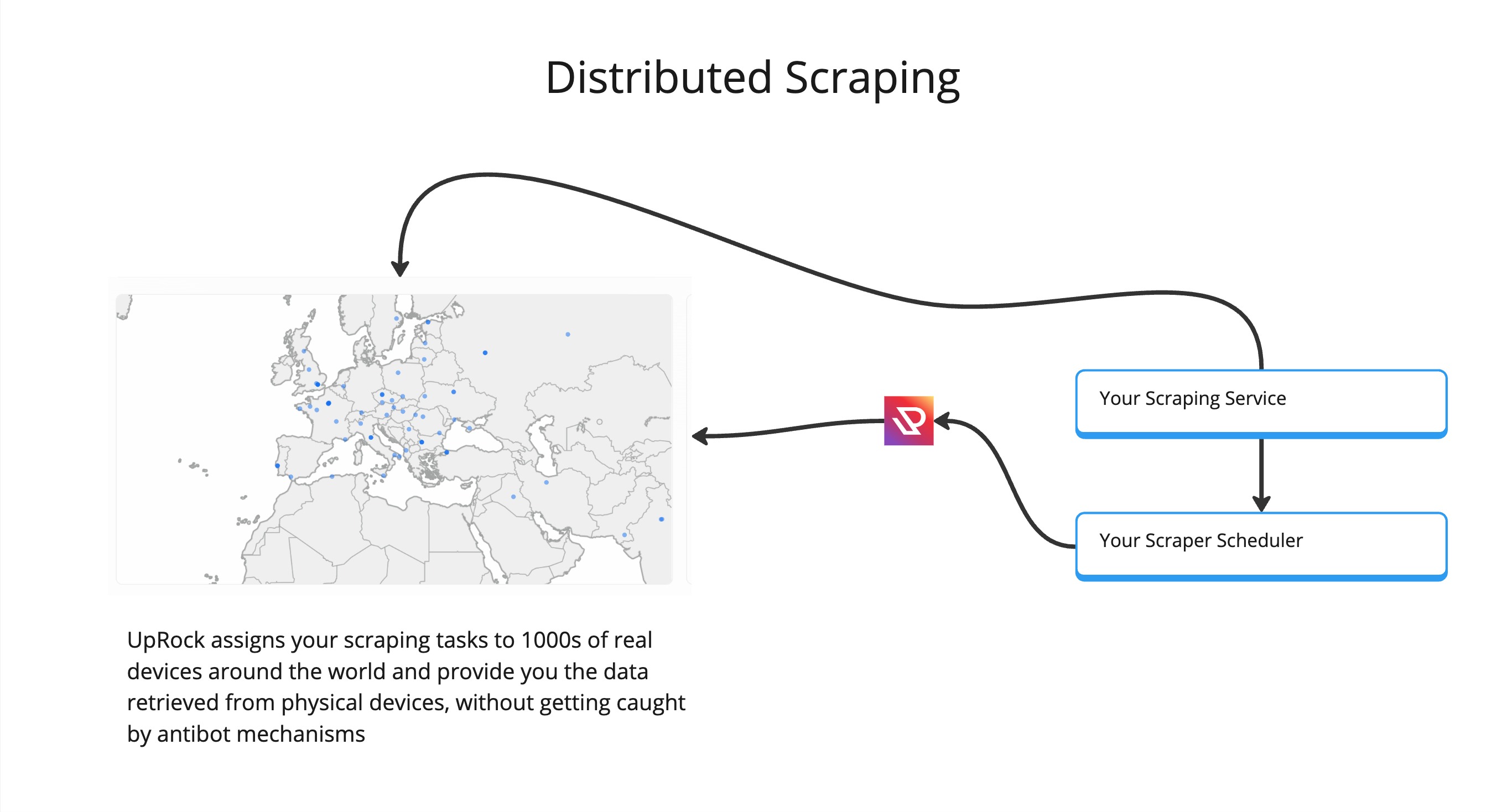
# Distributed scraping
Web scraping is met with resistance from website owners, who deploy various antibot mechanisms to prevent automated access.
Many antibot mechanisms blacklist known hosting provider IPs (AWS, GCP, DigitalOcean, etc.), because legitimate human users rarely browse websites from data centers.
Hosting provider-based scraping services face issues like:
* **Blocking**: Many sites block IPs from hosting providers.
* **Shared IP reputation**: Even if your scraper behaves ethically, bad actors using the same provider can lead to IP bans.
* **Easily detectable patterns:** Requests from hosting providers often lack natural browsing behavior. This makes them easier to flag.
* **High latency & costs:** Cloud-based scraping requires expensive proxies or VPNs to mimic residential traffic.
### UpRock's DePIN-powered web scraping solution
Decentralized Physical Infrastructure Networks (DePIN) provide an alternative to traditional cloud-based scraping. They consist of distributed, user-operated nodes that offer infrastructure services in a decentralized way.
This is where UpRock's DePIN network helps your company build a scraping solution superior to others.
Advantages of using UpRock's DePIN over traditional scraping solutions are as follows:
1. **Residential IPs:** Unlike cloud hosting providers, UpRock's DePIN infra (Prism) requests through real edge devices, making them harder to detect.
2. **Geographically distributed:** UpRock nodes in a DePIN network are spread across different regions. This reduces the risk of IP bans and enabling localized scraping.
3. **More anonymity:** Since traffic originates from various devices rather than centralized data centers, tracking and blocking individual scrapers is more difficult.
4. **Cost efficiency:** UpRock's DePIN infrastructure ischeaper than traditional proxy solutions because they leverage idle computing resources from hundreds of thousands of participants.
UpRock's solutions are not only for end users, but also for companies leveraging their scraping platform. By connecting your web scraping solution with UpRock, you can bypass many limitations emposed by platforms and CDNs like Cloudflare.
[Get in touch with us](https://uprock.typeform.com/access-prism) now to discuss your needs.
####